Some people look down at giving or receiving gift cards as presents, but not me. Needless to say I was in pig’s heaven when I scored a few Barnes and Noble gift cards for Xmas, and I wasted very little time in hitting their online store and making a list.
This time around – as I’ve done this before – I decided to hit up the Rocky Nook website to download their latest catalog of titles. I own a few of their books already, most recently Practical HDRI: High Dynamic Range Imaging for Photographers

The List
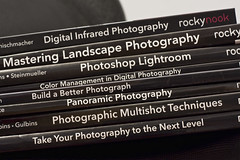
Here’s the list of 8 books in no particular order; unless you count the random order they’re shown in the photo above as being particular. :)
I ended up purchasing – 4 from Barnes and Noble, 4 from Amazon – but all the links below are pointed to Amazon since I think you’ll find their reviews to be helpful.
- Digital Infrared Photography
– for whatever reason, digital infrared photography is very intriguing to me, and I experimented a little with it last year using a Hoya R72 filter. This year, however, if my grand plans of getting a Canon 7D for my b-day (or $2,000 in gift cards ;)) come true, then my 20D is getting sent off to be IR-converted.
- Mastering Landscape Photography
– this title was an obvious one for me, since photographing the beautiful landscapes of Maui is what got me hooked on photography in the first place. This book was the first to arrive, so it got the dubious honor of being read first. So far, it’s pretty good.
- Managing Your Photographic Workflow with Photoshop Lightroom
– okay, so this one might be a little outdated and doesn’t cover the new LR3 Beta features. But seeing that I know nothing about Lightroom and the fact that I snatched up a used copy for $5, I couldn’t pass it up as an initial primer on the software.
- Color Management in Digital Photography
– two gadgets that I purchased late last year and have not yet made it to my depressingly-in-need-of-updating Gear section is a gorgeous 24” Dell Monitor and an Xrite Eye-One Display 2 monitor calibrator. I think I have the basics down, but this will be a great resource once I need to take the next step.
- Build a Better Photograph
– sure, it’s easy to create great images when you’re visiting the gorgeous island of Maui, or are a life-long hockey fanatic shooting 20 ft. from the action. But for times when I want to be a little more creative with everything else around me, I’m hoping this title will open my eyes a little.
- Mastering Digital Panoramic Photography
– shooting and stitching panoramas has always been fun for me, especially as a landscape photographer. Something about the challenge of capturing your full range of view that’s too large for a single frame I find very inviting. I’ve even spent time looking at specialized panoramic tripod heads, if you didn’t realize they had such a thing.
- Photographic Multishot Techniques
– along the lines of panos, shooting HDR, and to some extent astrophotography, there are even more projects you can do using multiple exposures of a single or related scenes. I recently played around with captures for various composites, and I think this is only the beginning for my creativity behind the camera.
- Take Your Photography to the Next Level
– fitting that this happened to be last on the list, since it seems to be the overall theme to this post. This one is intriguing to me because it’s an essay book and not a technical how-to. Much like my years of reading and learning the vast world of software and web development, it’s nice to be able to step back from all the numbers and acronyms and read a little theory and opinion once and awhile.
Phew, that’s a long list, and the kicker is that there were 5 more on the Rocky Nook catalog that I’m still interested in!
Used, But Good As New
One of the practices I started while burying myself in software and web development books in years passed was grabbing used books on Amazon, and in some cases B&N. I’ve been cautious, read seller reviews, etc., and in general have have been mostly satisfied.
Perhaps the obvious benefit to buying used books are the cost. Of the 8 titles above, I purchased all of them used, and the final total came out to roughly $120 – most of which was paid for in gift cards. At an average of $15 per book, that’s including shipping, you can fill a bookshelf pretty quickly.
All I Need Now is Time
What I chuckle about, as does my wife, is when I look at the stack of books on my desk and think to myself, “when the heck will I get to read all of those!” My cautious estimate at the moment, seeing that it’s almost the end of January, is that I’ll probably finish 5-6 this year, cover to cover. The others I might skim as needed, or revisit next year as I progress further in the photography realm.
In any case, with my life motto being “never stop learning” and all the momentum I’ve gathered around photography this passed year and a half, it just seems like a logical choice. As I do finish some of these titles, I will work on finding spare moments here at the blog to share short reviews and open a more focused dialogue for each. In the meantime, be sure to check out those links and read some of the customer reviews on Amazon, as well as the Look Inside! feature to see if any of these books might be interesting to you, too.
Thanks for reading this longer than normal post, and wish me luck!
– Kris
2 Comments
Hi Kris!
Wow, that’s quite a stack of reading you’ve got there! Glad you enjoyed Practical HDRI. Stay tuned, the 2nd edition with a good bit of updates and new information is due out late spring/early summer.
Good luck with the reading assignments! Catch you around!
Jack Howard
Hi Jack,
Thanks for the post. I was pretty intimated when I first saw HDR images on Flickr, but your book broke it down perfectly. Been meaning to write a review on it – I’m a little behind.
Looking forward to the 2nd edition, been tracking the updates on your book’s Facebook page. Best of luck with your book’s continued success.
– Kris